

As a writer, there���s nothing worse than having a deadline while staring blankly at a page trying not to panic as the ever-dreaded ���writer���s block��� sets in and threatens to ruin you. It doesn���t just happen to writers either. Every profession has its own special version of ���stuck.��� With all the complexities that come with innovation management, there are so many moving parts it���s easy to get overwhelmed, especially if you don���t have a sound plan on how to be successful.
We���ll help guide you through how to get the words on the page and get you ���UNstuck��� before the glue dries and you���re solidified in the spot you���re currently at.
Managing enterprise innovation is a uniquely challenging task: you���re walking a tightrope between sustaining forward momentum and adhering to stringent project deadlines, while maintaining a flexible pipeline that can rapidly adapt to shifting priorities. The desire to embrace bold risks and explore unconventional ideas constantly needs to be counterbalanced by the responsibility to manage budgets and hit revenue targets.
This tension creates a demanding environment for innovation managers. They���re under pressure to deliver tangible results and meet stakeholder expectations. But the very nature of innovation processes can often feel unpredictable and vague. The enterprise's financial stability hinges on anticipated product launch timelines, which can be disrupted by the uncertainty and potential setbacks characteristic of innovation.
Innovation often involves navigating uncharted territory, where the path forward isn���t entirely clear. This ambiguity can be unsettling for many organizations. The need to reconcile the unpredictable nature of innovation with the structured demands of the enterprise can create a sense of dissonance and tension for innovation management.
Growth innovation brings all of these areas into alignment. Your innovation pipeline can be pliable and predictable. You can boost revenue now while taking strategic, innovative swings. You can know where every active project is and when they will cross the finish line. Growth innovation is the key to unlocking innovation���s black box problem.
What is growth innovation?
Growth innovation is a management philosophy that prioritizes growth as innovation���s most critical outcome. However, it���s more than just a growth plan meant to increase revenue. A growth innovation strategy also helps you set innovation priorities and initiatives, allocate resources, and establish reporting protocols, giving stakeholders the information they need to keep the pipeline running smoothly.
Your growth innovation strategy will connect the dots between your innovation portfolio and the enterprise���s growth objectives, ensuring that your efforts always align with those goals. This is centered around three basic principles:
- Growth
By establishing a direct correlation between innovation initiatives and organizational revenue goals, projects aren���t disconnected from corporate objectives. Every innovation initiative is centered around hitting targets and contributing to organizational growth. - Visibility
There are stakeholders within and outside the innovation bubble, and their decisions are driven by various data points (resource allocation, project management data, timelines, process interdependencies, performance metrics, etc.). When everyone has access to the data they need, they���re equipped to address potential problems before things get off track���or grind to a halt entirely. - Orchestration
Traditional innovation management can obscure the interdependencies of your numerous initiatives and the ripple effects of various decisions and actions throughout the innovation process. Growth innovation ensures that each project is aligned with the entire portfolio and scales up to meet organizational growth and revenue objectives.
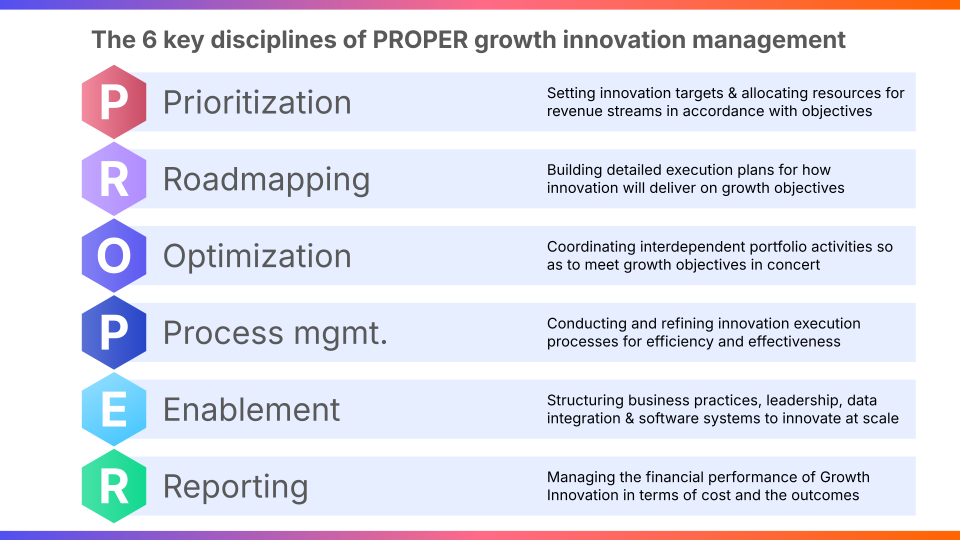
A functional growth innovation strategy relies on six key disciplines to put these principles into play, and the PROPER disciplines are:
Why do I need a growth innovation strategy?
Anyone managing innovation has already developed a process that works for them in some capacity. As you read through this, you���ll likely think, ���I understand these principles, and I do a lot of this intuitively.��� That���s probably true, but think of this moment as an opportunity to be a self-disrupter and not constrain yourself by what you already know.
Even if you have these steps perfectly crystallized in your head, documenting them can make a critical difference to your organization. Writing it down helps you formulate a system that allows for consistency���it gives you a process you can fine-tune. It also enables you to communicate it to the people who need to be aligned with your strategy. It goes from being a nebulous concept to a simple guideline.
Your growth innovation strategy will help you:
- Provide clear direction for your team
This strategy becomes a north star, aligning everyone���s efforts toward the same goals and ensuring everyone knows their role and how they contribute to the big picture.
- Justify your decisions
A documented strategy creates a solid rationale for your targets, initiatives, priorities, and resource allocation decisions.
- Encourage collaboration
Growth innovation breaks down silos, inviting input from executives and cross-functional teams. This input helps ensure that your innovation processes receive the most insightful input from critical stakeholders. - Optimize around controllable factors
By identifying and prioritizing the elements you can manage, you can proactively regulate risks and seize growth opportunities. Actively governing controllable factors ultimately increases the factors that are governable. - Quickly describe the implications of ad-hoc changes
Growth innovation enables you to recognize the interdependencies of your portfolio and quickly summarize how changes to one project will impact the others. - Facilitate strategic trade-offs
Managing innovation requires making tough choices. A growth innovation strategy enables you to evaluate options tactically and make prioritization and allocation decisions easier.
Creating a growth innovation strategy is a big deal, but putting it together doesn���t have to be. You can accomplish it by dedicating a few hours a month. Once you wrap your head around it, you can map it out on a whiteboard and communicate it easily���and it can fit on a single page!
Creating your growth innovation strategy
This process for crafting your innovation strategy is straightforward and made up of four distinct steps:
- Define the enterprise���s growth objectives
- Summarize your current innovation portfolio
- Craft your theory of the case for growth innovation
- Audit current innovation resource allocation
STEP 1: Define the enterprise���s growth objectives
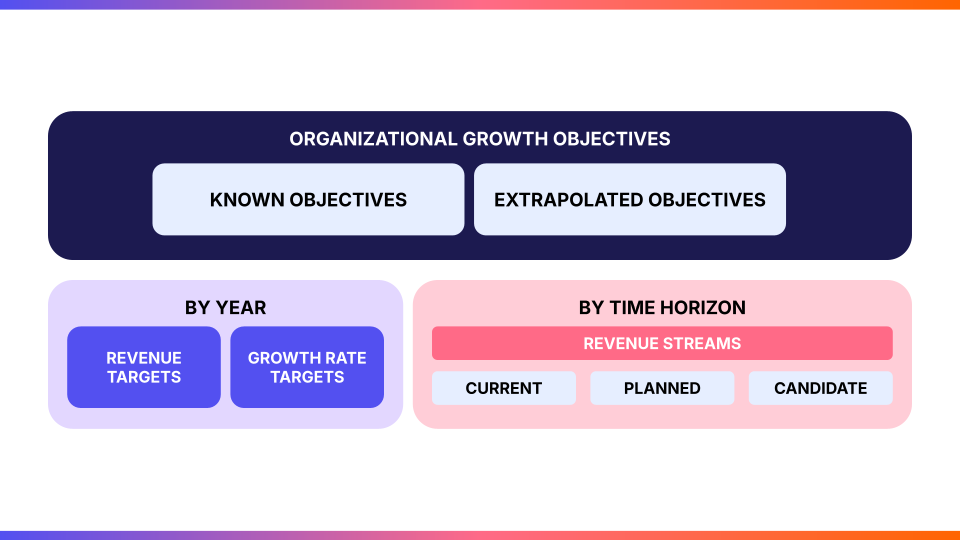
While specific growth objectives can differ between organizations, two fundamental elements remain consistent:
- Revenue: The income targets the enterprise is aiming for.
- Timelines: The strategic timeframes for completing projects and hitting revenue targets.
These objectives fall into a couple of categories:
- Known objectives: These are explicitly stated and can be found in various sources such as strategic documents, shareholder calls, and analyst reports.
- Extrapolated objectives: These are inferred or projected based on available information. They can be further categorized into:
- Based on historical trends: These objectives are derived from analyzing past performance and growth patterns.
- Based on expected future events: These objectives are formulated by considering anticipated events and their potential impact on the organization's growth.
Start by gathering the enterprise���s known objectives for the next five years. If a gap exists between the organization���s defined goals and the five-year mark, put together projected objectives based on historical data and any upcoming critical factors (regulatory changes, economic shifts, socio-political cycles, upcoming opportunities, etc.).
Identify revenue streams
The revenue targets you set in the time horizons will come from one of three streams:
-
Current: The existing revenue streams currently generating income for the business
-
Planned: New revenue streams that the business plans to introduce in the future
-
Candidate: Potential revenue streams that are being explored or considered for future development
Identify time horizons
Now, lay out a timeline for revenue streams over specific time horizons: short-term (usually years 0���2), medium-term (usually years 3���4), and long-term (year 5 and beyond). Your specific time horizons should reflect industry, business cycle, and strategic goals.
Identify revenue targets
Next, lay out the income numbers the enterprise is aiming for, and map those to the revenue streams that are expected to supply that income.
When you���re finished with this step, you should have:
- Defined or projected enterprise goals for the next five years
- The revenue streams responsible for achieving those targets
STEP 2: Compile a comprehensive summary of your current innovation portfolio
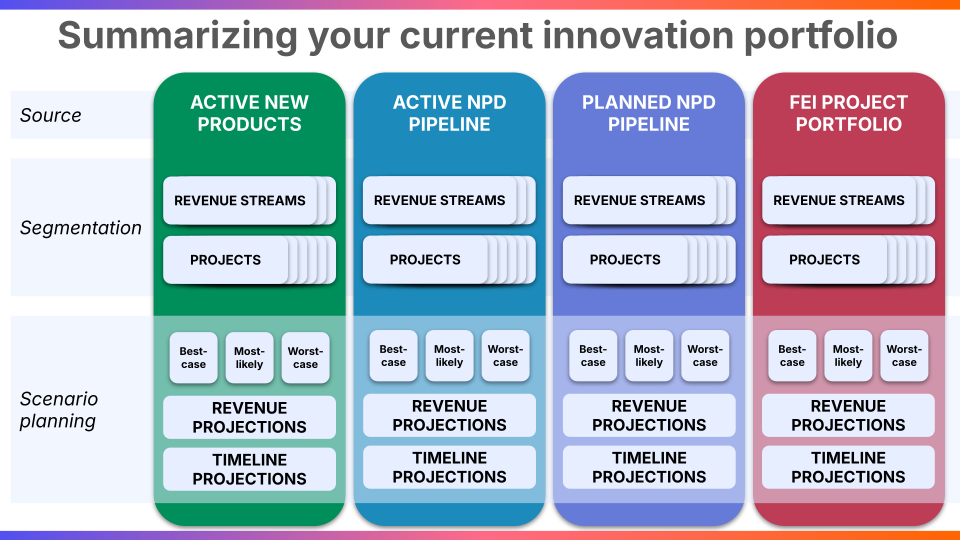
Now that you have a firmer grasp of your organization���s objectives and revenue targets, it���s time to get a handle on your current, planned, and candidate revenue streams. This means creating a comprehensive inventory of four distinct areas:
- Active new products: All new products currently generating revenue
- Active NPD pipeline: New products currently in development
- Planned NPD Pipeline: New products scheduled for development
- Front-end project portfolio: Early-stage product concepts and ideas
These sources can be segmented by revenue streams and individual projects���or whatever segmentation most logically maps to the enterprise objectives you identified in Step 1. For each segment, you���ll need to gather the following information:
- Best-case, worst-case, and most-likely scenarios
- Projected revenue from each revenue stream
- Projected timelines for that revenue
STEP 3: Craft your theory of the case for growth innovation
The first two steps laid the groundwork for this stage of the process. This is where you begin directly linking innovation projects and initiatives to enterprise objectives.
Map innovation projects to revenue streams
The innovation projects in the pipeline (along with the planned and front-end projects) that you identified in Step 2 need to be linked to the time horizon revenue streams from Step 1. Everything in the innovation portfolio should be tied to a measurable projected impact on the company's financial goals.
Group innovation projects based on the overarching business objectives they support, so you have a clear alignment between project outcomes and strategic priorities.
Assuming all other growth factors remain constant, determine what innovation needs to do to meet the enterprise growth objectives. Set specific, measurable targets for innovation outcomes to enable the company to reach these goals.
Part of this process involves identifying and documenting key assumptions underpinning the projected performance of innovation projects. These include assumptions about customer behavior, market trends, technological changes, and the competitive landscape. Have these assumptions been tested and validated through market research, customer feedback, and other analyses? Has enough rigor been dedicated to this analysis to ensure confidence in these assumptions?
Compare innovation needs against the current innovation portfolio
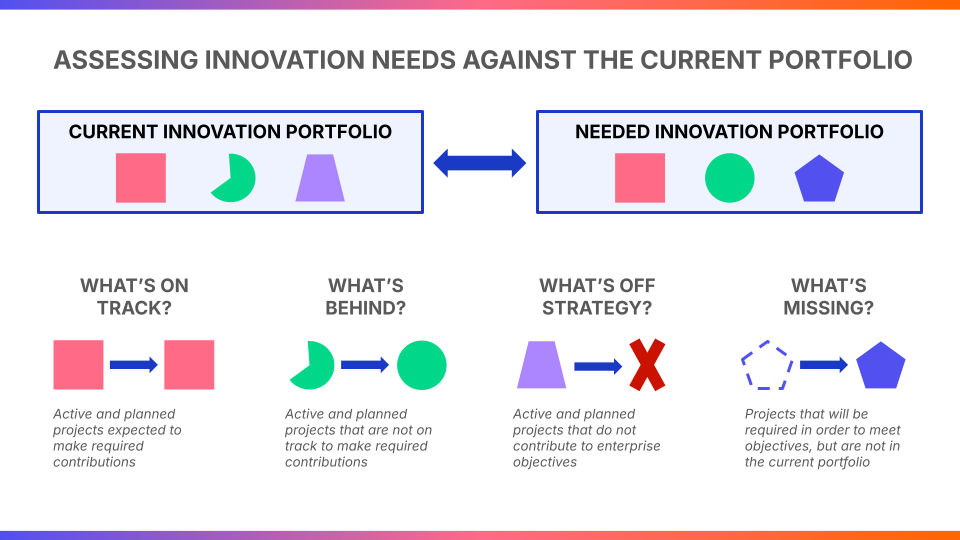
Now you can begin examining where you���re on course to meet objectives, and identify any problem areas. This is achieved by scrutinizing three specific areas:
- On-track projects: These are goals with planned revenue streams supported by innovation projects whose projections are in line with those goals.
- Revenue gaps (innovation performance issues): Identify areas where planned revenue streams have supporting innovation projects, but those projects are not projected to generate sufficient revenue to meet enterprise objectives.
- Portfolio gaps (missing innovation initiatives): Identify planned revenue streams lacking supporting innovation projects.
Prioritize innovation projects
Many innovation shops find that only 20 percent of their projects generate 80 percent of their portfolio���s value. This also means that 80 percent of their investment only produces 20 percent of their portfolio���s value. The goal is to avoid these low-impact projects that take time, energy, and resources but dilute your portfolio.
This problem can be remedied by ranking your current and planned innovation projects based on their potential to contribute to enterprise growth objectives, considering factors like projected revenue impact, strategic alignment with enterprise objectives, time to market, and resource requirements.
STEP 4: Audit your current innovation resource allocation
Once you���ve prioritized your innovation projects by alignment with enterprise objectives, it���s time to review the resources allocated to them. Are the financial, human, and technical resources distributed in a way that aligns with their priority?
Align your resource allocation plan to growth innovation targets
Based on your identified gaps and idealized allocations, determine specific actions that can be taken to realign resource allocation. After getting the necessary buy-in from any specific stakeholders, set a timeline for implementing these changes and assign responsibility to specific individuals or teams.
Identify resource allocation gaps
Pinpoint areas where the current resource allocation does not align with your identified priorities and needs. Can you determine the reasons for these incongruencies, like misaligned goals, inaccurate forecasting, changing market conditions, or inefficient processes? Make your best effort to quantify these gaps.
Create a structure to fix these gaps
Establish a framework for making future resource allocation decisions consistent with this ideal state. This will require maintaining an up-to-date list of future projects and their projected impact on enterprise objectives. If you���re interested in how to maintain this fluid project list, we���ve written articles that cover it for new product development, front-end innovation, and overall portfolio management.
Download the Growth Innovation Strategy Template
We���ve put together a Growth Innovation Strategy Template to help expedite some of this process and help you visualize the strategy. Download it and fill it out, and you���ll have a tool for communicating the strategy to your innovation teams and other stakeholders.
Also, once you���ve filled out this template, you should be able to recreate the process for any audience at any time with a simple whiteboard and marker.
Set your course for the future
The steps outlined here will set you up with a growth innovation strategy, but that���s only the beginning. Now you���ll need to execute your plan. Once you have governance to align your activities with your strategy, your innovation portfolio will start meeting critical enterprise objectives.
Growth innovation methodology propels your enterprise into an advanced stage of innovation management, which can lead to significant transformations in how the organization approaches innovation planning, execution, and evaluation. If you���re ready to take the next step in reinventing your organization���s innovation culture, check out ���The Enterprise Leader's Guide to Building a Growth Innovation Culture.���
Get your hands on the tech solution that will equip you to do it at scale, giving you real-time auditing, role-based workflows, and metrics that make sense.